If you’ve wondered whether links still matter, numbers are surprisingly clear: yes, and in ways that are more nuanced than ever. The landscape isn’t about “more links = better rankings” anymore; it’s about which kind of links, from which channels, and with what kind of impact.
This article walks through a series of clearly defined categories, each packed with specific stats you can use to sharpen your strategy.
Overall Importance of Backlinks
Before diving into tactics, let’s ground things with a few big‑picture figures.
- About 67.5% of SEO experts say backlinks still play a huge role in how search engines rank pages. This underlines just how central external signals remain.
- Around 48.6% of SEO professionals rate digital PR as the most effective link‑building tactic, which shows that high‑trust editorial signals are still viewed as gold.
So, practically, if your SEO approach ignores links, you’re working against the consensus of a large majority of SEO professionals who say backlinks matter significantly.
Link Acquisition: How Often Sites Get Backlinks
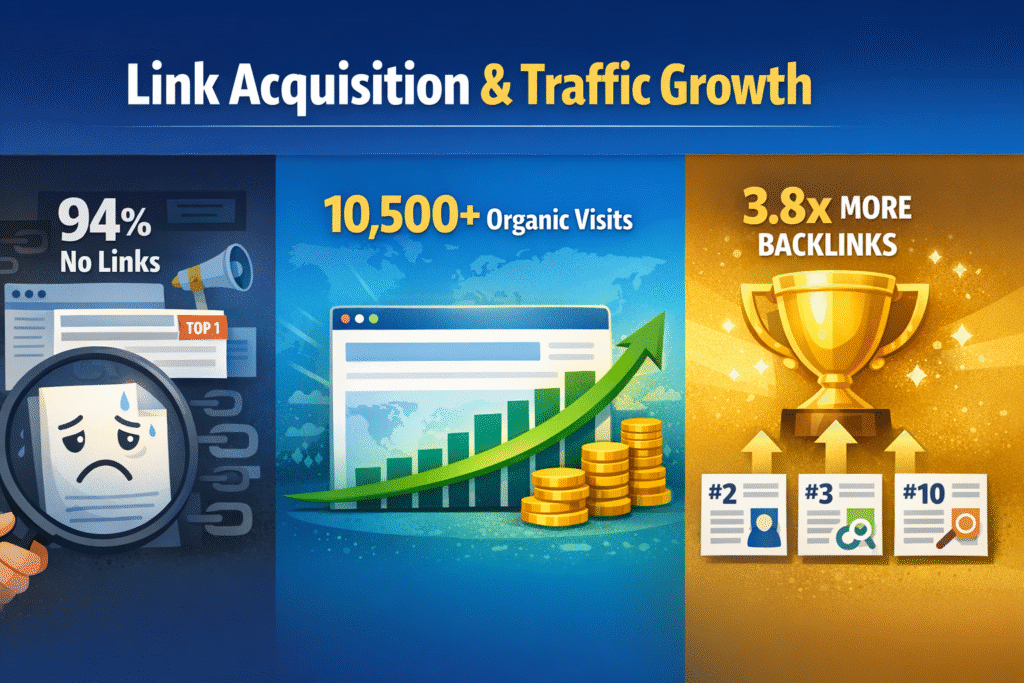
These stats reveal just how “dark” the web really is from a linking perspective.
- About 94% of online content fails to secure a single external link. It means most pieces of content never trigger any outbound mentions at all.
- Sites with more than 30 referring domains typically receive at least around 10,500+ monthly organic visits. This demonstrates how quickly link value scales once a threshold is crossed.
- The top‑ranking page for a keyword has about 3.8x more backlinks than pages ranked #2 to #10. This gives you a concrete sense of the gap between leaders and laggards.
For your planning:
- The default fate of content is “link‑empty.”
- Cross a minimal but meaningful link‑profile threshold, and organic traffic often jumps into five digits per month.
Tactics: Which Link‑Building Channels Move the Needle
Different categories of tactics produce different results. Let’s find out how.
A. Digital PR and Press‑Style Outreach
- About 48.6% of SEO professionals say digital PR is the most effective link‑building method, far ahead of many other channels.
- Exactly 50% of SEO experts say digital press releases, content marketing, and guest posting are among the strongest tactics for earning links, showing that press‑style content still carries weight.
- Around 45% of SEOs use digital PR at all, which highlights that many marketers underuse one of the most effective tactics.
PR–style work is not reserved for huge brands; it’s about story‑driven content and data‑backed angles that journalists or niche publications can reference.
B. Content Marketing and Link‑Worthy Assets
- Content‑driven link‑building now accounts for about 67% of successful campaigns, meaning the majority of winning efforts start with an asset‑first mindset.
- “Why” posts, “what” posts, and infographics are often the top‑performing content types for earning backlinks, which matches what many tests show in practice.
- Topically relevant links are worth roughly 2 to 5x more than generic ones, encouraging you to anchor links inside high‑intent contexts.
You can package this roughly into:
| Content style | Observed behavior in studies |
| “Why” and “what” posts | Frequently top‑link‑earning formats |
| Infographics | Consistently earn high amounts of links |
| Deep, long‑form guides | Often associated with strong domain‑level growth |
So, fewer but heavier assets with strong angles will usually outpace lots of shallow content.
C. Guest Posting and Link Insertions
- About 64% of link builders still use guest posting as a primary tactic, showing it remains widely used.
- Roughly 10% of SEO professionals still rely on link insertions (paid content additions with links) as part of their mix, though this share has fallen slightly as guidelines tighten.
In practice:
- Guest posts still work well when placed strategically on topically relevant, mid‑ to high‑authority sites.
- Link insertions earn a valuable but shrinking niche; many experts now prefer safer, editorial‑style placements.
Metrics: What Kinds of Links Marketers Track
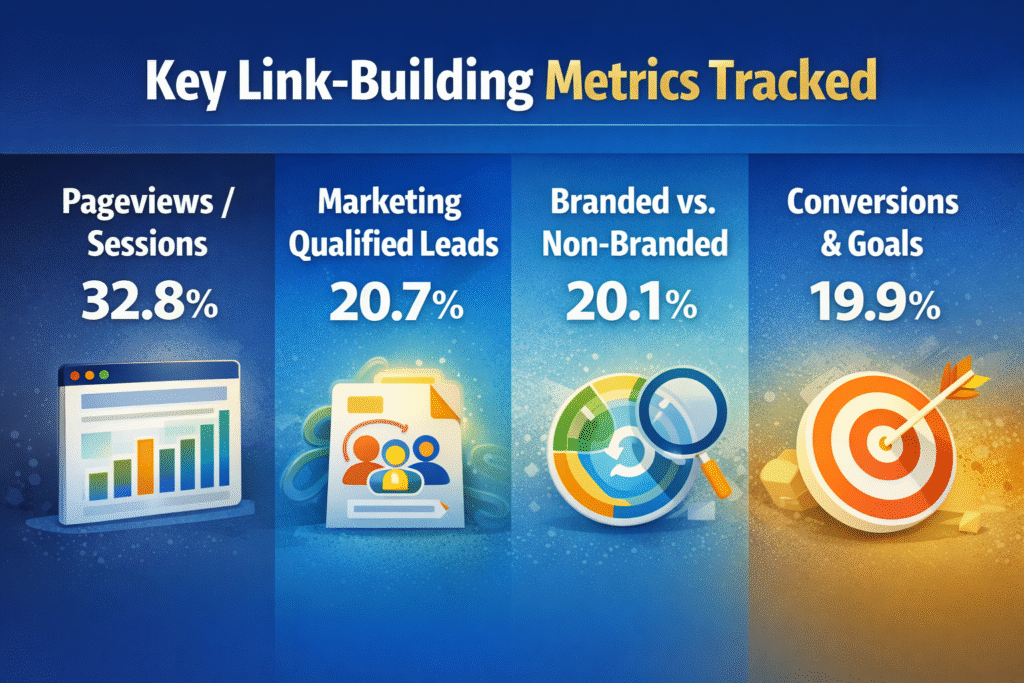
Different SEOs look at entirely different numbers. Here’s where the focus usually lands, based on how sources phrase their surveys.
- When asked which metric they primarily use, 32.8% of marketers chose “pageviews/sessions” as the main KPI for tracking link impact.
- 20.7% of teams track marketing‑qualified leads, which is a step closer to business impact.
- 20.1% of marketers track branded vs non‑branded traffic, a useful proxy for authority growth.
- 19.9% of SEO professionals track conversions and goal events, tying links more directly to business performance.
Here’s a tight visual snapshot:
| KPI tracked | Percentage cited |
| Pageviews/sessions | 32.8% |
| Marketing‑qualified leads (MQLs) | 20.7% |
| Branded vs non‑branded traffic | 20.1% |
| Conversions/goal events | 19.9% |
This gap between traffic and revenue‑tracking is one of the easiest inefficiencies to fix in your own strategy.
Link‑Building Behavior: How Teams Work
The way teams handle link building reveals a lot about what’s realistic versus aspirational.
- Guest posting remains the most popular tactic, used by about 64% of link builders, which implies a fair bit of link‑stacking happens without deep planning.
- A significant majority of experts still lean on habitual practices like guest posting and comment links, which implies that many link‑building workflows are fairly ad‑hoc.
- Content‑driven link‑building now accounts for roughly 67% of successful campaigns, which encourages more structure around asset‑first work than random link‑grabbing.
Types of Valuable Link Targets
Different targeting strategies give different lifts.
- Links from the same domain start to show diminishing returns after around 5–7 links, which means authority doesn’t scale infinitely within a single site.
- Topically relevant links are worth roughly 2–5x more than generic ones, pushing targeting toward context, not pure quantity.
- Many SEOs increasingly focus on where their audience already reads, which aligns with a shift toward audience‑relevant domains over pure high‑DR targets.
So, in planning:
- Use authority + trust metrics to filter who you target.
- Use topical relevance and audience‑behavior signals to decide which links you fight hardest to earn.
Link‑Building Cost and ROI
Everyone hates playing with blind budgets. Here’s what the numbers show:
- The average documented cost per high‑quality backlink sits around $361, with a year‑over‑year increase of about 14%.
- AI‑assisted outreach tools helped cut campaign costs by roughly 31% on average, largely by streamlining research and template management.
- Average minimum monthly budgets for link‑building in competitive niches hover near $8,406, giving you a sense of what serious programs invest.
Where Links Come From: Outreach Channels and Habits
These stats will help you allocate effort across channels.
- About 12 to 18% of typical outreach campaigns end up converting into live backlinks, with top‑performing teams clearing 25%+.
- A majority of SEOs still lean heavily on email‑driven outreach, even as newer AI tools and assistants emerge.
- Paid‑link‑use admissions have slightly declined to around 21% of SEO professionals, indicating more caution around risky tactics than in earlier years.
Vertical‑By‑Vertical Reality Check
Different niches respond differently to link‑building efforts. Some surveys spell this out clearly.
- Fashion, beauty, education, and health and wellness often show up as among the hardest verticals for acquiring backlinks, due to tight competition and strict rules.
- Travel‑ and experience‑driven sectors tend to be among the easier categories to earn links in, especially when visuals and stories are involved.
- Finance and insurance companies with pages at or near the top of Google typically have about 3.8x more backlinks than those further down, illustrating how competitive links sit in those niches.
Travel and visually rich narratives = generally easier to build links into.
Highly regulated niches (finance, law, health, education) = higher threshold to reach and keep links, especially from authorities.
Quick Action Checklist You Can Use Now
- Build one strong, data‑ or asset‑driven piece per quarter (research‑heavy post, tool, or detailed guide), positioning it as you’d position a reference source rather than a marketing asset.
- Use digital‑PR–style outreach and press‑story framing (Stat: 48.6% of SEO pros say PR‑style methods are the most effective tactic) rather than generic “guest‑post‑for‑backlink only” language.
- Structure email outreach as a lean, data‑driven sequence (Stat: typical success rates 12 to 18%), with personalization and follow‑ups as your main levers.
- Track at least two KPIs beyond visits: sessions, leads, and eventually revenue tied to specific campaigns.
Current and Future Link‑Building Trends
| Dimension | Current trends | Future shift |
| Where “success” lives | Success often lives in link counts, DR lift, and top‑10 rankings for a handful of keywords. | Success shifts to buyer‑journey visibility: brands will care more about appearing inside real purchase‑related reading. |
| Relationship density | Teams typically run loose relationships: one‑off outreach, scattered guest posts, and occasional mentions. | Brands will start seeing each powerful publisher as a recurring partner and build multi‑campaign relationships. |
| Quality filters | Teams often filter sites by DA/DR, organic traffic, and general “authority.” | Filters will deepen into audience‑behavior signals: Does this site compete with the buyer‑education content we want to win for? Is it already where our customers read before purchasing? |
| Budget timeline | Budgets are treated campaign‑by‑campaign, with many brands doing “sprints” and then pausing until rankings stall. | Forward‑looking programs will treat link building like a continuous, evergreen function, with modest but steady monthly allocations. |
| Team ownership | As detection improves and algorithm shifts mature, teams will increasingly prioritize “link‑cleanliness” as a SaaS hygiene layer. | Integration will increase: product‑team input, content‑team storytelling, and customer‑success case‑studies will all feed into a single, cross‑departmental link‑planning process. |
| Risk tolerance | Marketers still test boundary‑pushing plays, hoping they slip below the radar. | As detection improves and algorithm‑shifts mature, teams will increasingly prioritize “link‑cleanliness” as a SaaS hygiene layer. |
| Metrics visibility | Leaders often only see a high‑level summary: total links, highest‑DR sites, and top‑performing pages. | The norm will be link‑mapping dashboards where stakeholders can track per‑campaign link diversity, page‑level traffic uplift, and conversion‑impact. |
| Differentiation in the market | Agencies and in‑house teams compete largely on volume and speed, often pitching “we’ll get you X links” by Y month. | Sustainable differentiation will come from portfolio‑grade proof showing long‑tail, purchase‑intent‑friendly mentions, co‑produced research, and media‑style coverage. |
Link Building Remains Non‑Negotiable for SEO Leadership
As you just saw, link building is no longer just about more links but about earning the right links in the right context. Modern statistics make one thing unmistakably clear: backlinks still shape rankings, traffic quality, and how much trust Google and buyers place in your domain.
Brands that treat link building as a structured and insight‑driven function end up with more resilient traffic, higher‑intent visitors, and stronger negotiating power in the SERPs. In today’s world, the competitive edge doesn’t go to whoever publishes the most articles. It goes to whoever builds the most credible, relevant, and enduring link profile over time.
If you’re a SaaS or B2B founder ready to turn link‑building data into real ranking and revenue growth, 2xSaS offers a focused partnership you won’t find at general‑audience agencies. To benchmark your current link strategy against what the latest data suggests, schedule a quick call with us.
