If you’ve been investing in link building and wondering when the rankings will finally appear, this article is for you.
Most sites start seeing measurable SEO results within 2 to 3 months, with peak results typically arriving around the 6 to 8 month mark.
But the real story is more nuanced than any single timeline, and understanding what actually happens behind the scenes will help you make smarter decisions and set realistic expectations.
Why You Should Keep Reading
- Know what to expect and when. No more guessing if your campaign is on track
- Understand the 3-phase process every backlink goes through before rankings move
- Get a month-by-month timeline of how real link-building results unfold
- Learn the 5 factors that speed up or slow down your results
- Walk away with pro tips, tracking methods, and next steps you can act on immediately
So, let’s get right into it.
The Honest Timeline: What to Expect Month by Month
There’s no universal clock for link-building results, but there is a consistent pattern. The process unfolds in phases: crawling and indexing, initial ranking shifts, and then the gradual compounding effect.
Here’s how that typically looks:
| Phase | Timeframe | What’s Happening | Expected Outcome |
| Indexing | Weeks 1 to 4 | Google discovers and indexes your new backlinks | No visible ranking changes yet |
| First Movement | Months 1 to 3 | Early ranking signals begin registering | Minor improvements for low-competition keywords |
| Noticeable Gains | Months 3 to 6 | Authority starts compounding; more keywords begin moving | Measurable traffic increases, especially for mid-tail terms |
| Peak Impact | Months 6 to 12 | The full weight of your link profile takes effect | Significant ranking gains, growing organic traffic |
| Sustained Growth | 12+ Months | Ongoing link acquisition compounds with older links | Compounding authority; improved domain-wide rankings |
Takeaway: Link building is not a one-and-done tactic. It’s a compounding investment. The longer and more consistently you build quality links, the greater the return.
Next Step: If you’re in months 1 to 2 of a campaign, first confirm your links are indexed (typically 1 to 2 weeks for quality placements via Google Search Console’s “Links” report or site: operator).
Then track early wins like rising impressions or minor position gains on low-competition terms. Businesses often see these first signals within 4 to 8 weeks, keeping momentum high.
Why Does It Take This Long? The 3-Phase Process
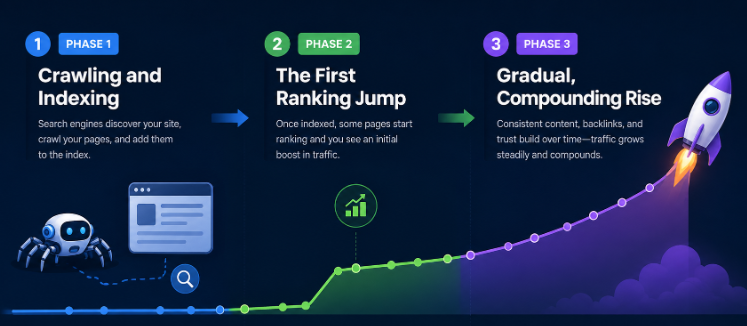
When you understand why link building takes time, it will help you stay the course instead of pulling the plug too early. There are three distinct phases every backlink goes through before it moves your rankings.
Phase 1: Crawling and Indexing
Before a backlink can influence your rankings, Google’s crawlers need to find it. This isn’t instantaneous; it depends entirely on how often Google visits the linking site. A high-traffic news site might get crawled within hours. A niche blog updated quarterly might take weeks. Once Google crawls the page, the link gets indexed, which is the starting point for it to carry any SEO weight.
Pro Tip: To speed up the indexing of your backlinks, request indexing of the linking page via Google Search Console if you have access. Alternatively, sharing the linking page on social media creates additional crawl signals.
Phase 2: The First Ranking Jump
After indexing, pages often experience what SEOs call the “first jump”, a sudden improvement in rankings as Google starts weighing the new link’s authority. A page sitting at position 120 might jump to position 40. This phase typically kicks in 4 to 8 weeks after a link is indexed, and it’s usually the most exciting part to watch. Don’t mistake this initial jump for the full effect, though; it’s just the beginning.
Phase 3: Gradual, Compounding Rise
This is where most of the real value lives. After the initial jump, Google gradually adjusts rankings as it observes user engagement with your content, the continued presence of your links, and how your page compares to competitors for more and more queries. This compounding effect is why campaigns that run consistently for 12+ months outperform short-term bursts significantly.
“There could be one really good link from one website out there that is, for us, a really important sign that we should treat this website as something that is relevant because it has that one link.” — John Mueller, Search Advocate at Google
Takeaway: Expect a 3-phase arc: indexing, a first jump, then a gradual rise. The most sustainable growth happens in phase three, which is why patience is a competitive advantage.
5 Factors That Determine How Fast You’ll See Results
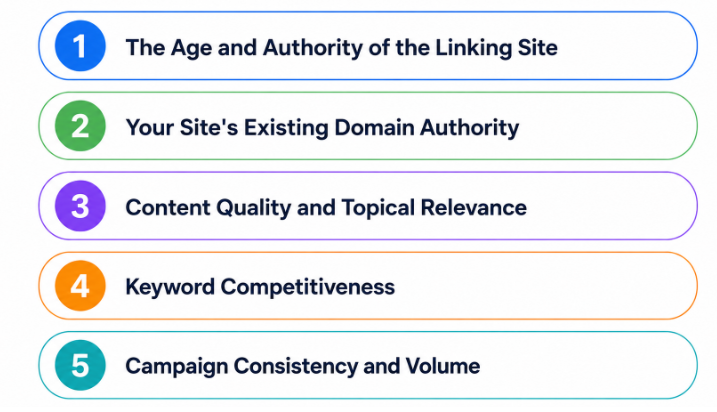
Two sites can run the exact same link-building campaign and see wildly different timelines. Here’s what drives that difference:
1. The Age and Authority of the Linking Site
A link from a well-established domain with a strong backlink profile carries significantly more weight, and often gets indexed faster than a link from a newer or less authoritative site. Quality over quantity isn’t just a cliché here; it’s the difference between a ranking boost in 4 weeks versus 3 months.
The data backs this up: Top-ranking pages have an average of 2,418 backlinks, and domains with higher authority scores consistently outrank those without. Where your links come from matters just as much as how many you have.
2. Your Site’s Existing Domain Authority
A new site starting from scratch will typically wait longer to see results than an established domain that already has some authority. This is because Google needs more evidence before ranking a young domain. New sites often experience a “sandbox” effect where rankings are suppressed during the early months regardless of link quality.
Pro Tip: If your site is under 12 months old, prioritize brand mentions, directory listings, and topically relevant niche links in your early link building. These help establish trust faster than high-volume outreach to unrelated sites.
3. Content Quality and Topical Relevance
Backlinks amplify what’s already there. If your page has thin, generic content, even strong backlinks will have a limited effect. Google’s algorithm has become increasingly sophisticated at evaluating whether a page deserves the authority being passed to it. Links pointing to genuinely useful, well-structured content compound faster.
Here’s a sobering stat: 96.55% of online content gets zero traffic from Google. A significant driver of this is the lack of backlinks, which, combined with low-quality content, the two reinforce each other in both directions.
4. Keyword Competitiveness
Targeting “best CRM software for enterprise” is a fundamentally different battle than targeting “CRM software for florists in Denver.” Highly competitive keywords require more links, higher-authority links, and more time before you crack page one. Setting realistic expectations based on keyword difficulty is one of the most underrated parts of campaign planning.
5. Campaign Consistency and Volume
Sporadic link building, a burst of 20 links followed by 3 months of nothing, produces erratic results. Google values natural, consistent link velocity. A steady cadence of 5 to 10 quality links per month will typically outperform a one-time push of 50 links, both in terms of timeline and sustainability.
Takeaway: The sites that see results fastest share three traits: they have strong existing content, they’re targeting achievable keyword difficulty levels, and they’re building links consistently rather than in bursts.
Real-World Timeline: What a Healthy Campaign Looks Like
To make this concrete, here’s a realistic scenario for a mid-sized SaaS company targeting competitive B2B keywords:
| Month | Activity | Typical Outcome |
| 1 | Outreach begins; first 2 to 4 links secured | Links indexed; minor movements may be there or may not be visible yet |
| 2 to 3 | 15 to 20 additional links from DR 40 to 60 sites | Minor improvements on long-tail variants; impressions rising in GSC |
| 4 to 5 | Consistent cadence continues; anchor text diversified | 2 to 5 position jumps on primary targets; traffic starting to climb |
| 6 to 8 | 30 to 50 total links; internal linking optimized | Meaningful traffic gains; some target keywords hit page 2 |
| 9 to 12 | Total link count at 60 to 80; topical authority building | Page 1 rankings for several targets; compounding traffic growth |
| 12+ | Ongoing maintenance and new page campaigns | Domain-wide authority improvement; faster results on new content |
Pro Tip: Track your link-building results in Google Search Console, specifically, watch the “impressions” graph before rankings fully move. Rising impressions with stagnant clicks is a strong signal that rankings are about to shift upward.
Common Mistakes That Slow Down Results
Several link-building behaviors predictably delay results, or worse, cause Google penalties that set you back months:
- Building links to your homepage only. Distributing links across target pages spreads authority more effectively.
- Prioritizing quantity over quality. Ten links from mediocre sites rarely outperform one link from a respected industry publication.
- Ignoring anchor text diversity. Over-optimized anchor text is a red flag to Google. Aim for a natural mix of branded, naked URL, and partial-match anchors.
- Stopping a campaign too early. Many businesses quit at the 2 to 3 month mark, right before the compounding effect kicks in.
- Building links to pages with thin content. Backlinks amplify existing page quality; if there’s nothing to amplify, results will be minimal.
“In marketing, the reason that so many long-term plays work so well is that those people have patience, because they’ve invested over a long time, and because very few people are willing to have that patience and that tolerance.” — Rand Fishkin, Co-founder of SparkToro and Moz
Takeaway: Patience and consistency aren’t just virtues in link building; they’re the real strategy. The businesses winning in organic search are those who committed to a 12-month view while their competitors gave up at month three.
How to Know If Your Link Building Is Working
While you’re waiting for rankings to move, there are early indicators that your campaign is on the right track:
- Impressions are rising in Google Search Console (even before clicks follow)
- New keywords are appearing in your GSC keyword report, even at low positions
- Your domain’s DR/DA score is gradually increasing month over month
- Referring domains count is growing consistently
- Target pages are moving up, even from position 45 to 30 is meaningful progress
Worth noting: Only 1.74% of pages will rank in the top 10 within a year of being published, and that’s with active link building. For pages with no backlinks, the odds drop dramatically. Seeing any upward movement in months 1 to 6 is a genuine signal that your campaign is working.
Next Step: Set up a simple monthly tracking sheet with four columns: referring domains added, target keyword positions, organic impressions (from GSC), and organic sessions. Reviewing these together tells a more complete story than rankings alone.
What 2xSAS Does Differently
At 2xSaS, we build campaigns designed around data-informed and realistic timelines. Every client engagement starts with an honest assessment of where the domain stands, what keyword opportunities are within reach, and what link velocity is required to compete in their specific niche.
We track early indicators alongside rankings, so you’re never left wondering if anything is working. And we build links the way Google rewards: consistently, contextually, and from sites that matter in your industry.
Remember: When evaluating any link-building service, ask two questions: What does your link quality assessment process look like? And what early metrics do you track before rankings move? The answers will tell you whether you’re dealing with a serious agency or one that’s selling you on hope.
The Bottom Line
Link building takes time, typically 2 to 3 months to see meaningful movement, and 6 to 8 months to reach peak impact. That’s how Google is designed to work. Sustainable rankings are built on sustained effort.
The businesses that win long-term in organic search are those who understand this and commit to the full timeline. Every quality link you build today is compounding interest in your domain’s future authority. Start now, stay consistent, and measure the right things along the way.
If this article gave you clarity, imagine what a full strategy could do. Visit 2xsas.com.
