Link inserts, also known as niche edits or link insertions, are one of the most efficient ways to grow a site’s backlink profile without creating entirely new pages on third‑party sites.
Businesses outsourcing link‑building or running an in‑house SEO team should master link‑insertion workflows. It can shorten the time to first‑page rankings and improve ROI on outreach campaigns.
For a link‑building agency like 2xSaS, the key is not just “getting links” but earning contextually relevant and high‑trust placements that behave like natural editorial references.
This guide presents a step‑by‑step, evidence‑driven blueprint you can reuse across clients. But before we get to that, let’s understand a few things.
What Link Insertion Really Is
A link insertion is a backlink added to an existing, published article on another website, rather than publishing a new guest post or resource page.
Common naming variants:
- Niche edits
- Link inserts
- Contextual in‑content links
What makes it powerful:
- The host page is already indexed, often has traffic and backlinks, and is recognized by search engines as “mature” content.
- You don’t need to write a full article for the publisher. Instead, you propose a relevant and value-added edit to their existing piece.
When Link Insertion Makes Sense
Link insertions are especially useful when:
- You have strong, link‑worthy assets (guides, tools, research) and want them referenced in existing content.
- You want a faster impact than guest‑post campaigns, since the host page is already indexed.
- You are targeting mid‑ to high‑authority sites where full guest‑post acceptance is slow or competitive.
Industry data show:
- Average outreach‑to‑link conversion for all link‑building is about 1.7% of emails sent.
- For niche‑edit (link‑insertion) requests, the average positive‑response rate is around 38% among those who reply, but only about 5.3% of emails receive any reply at all.
So, while link‑insertion success is not guaranteed, it sits in the same ballpark as guest‑post and resource‑page outreach, with a clear edge in speed and fit if done correctly.
Step‑by‑Step: How to Build Links via Link Insertion
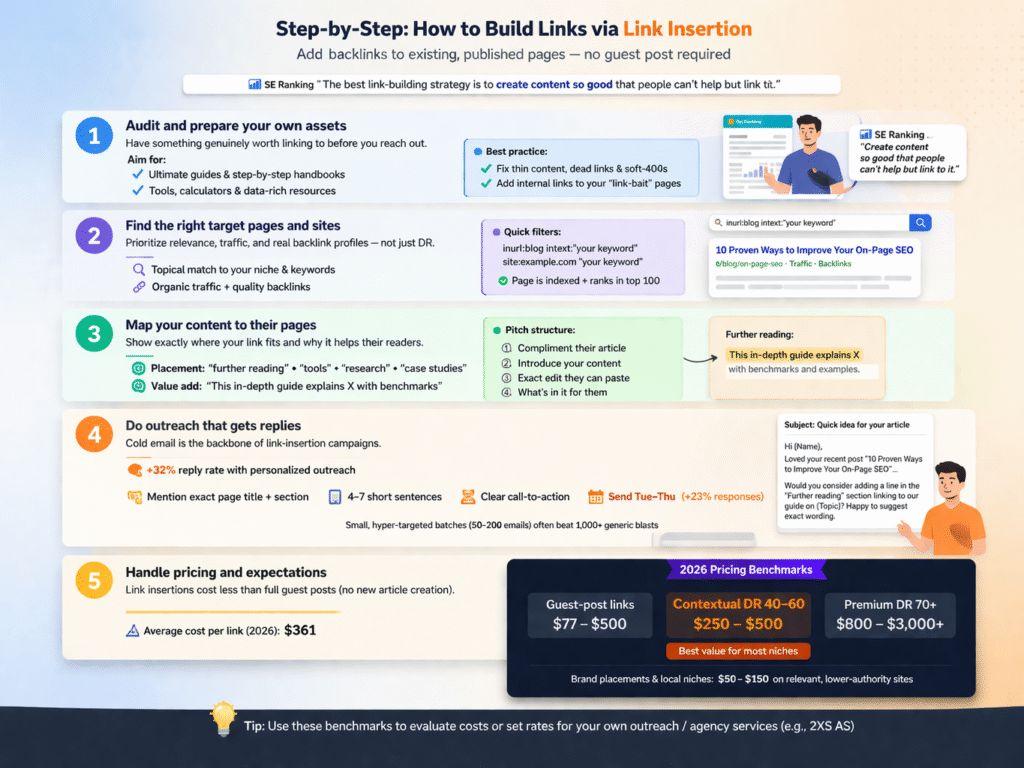
1. Audit and prepare your own assets
Before reaching out, ensure you have content that is genuinely worth linking to.
Aim for:
- Comprehensive guides (e.g., “ultimate guides,” step‑by‑step handbooks).
- Tools, calculators, or data‑rich content that can be cited as a reference.
Best practice:
- Fix thin content, dead links, and soft‑404s on the target URLs.
- Add internal links from high‑traffic pages to your “link‑bait” assets.
As a leading SEO performance and rank‑tracking platform observed, the best link-building strategy is to create content so good that people can’t help but link to it.
2. Find the right target pages and sites
Don’t just look at “high DR” domains. Instead, prioritize:
- Topical relevance to your niche and target keywords.
- Existing organic traffic and backlink profile (not just DA/DR).
Quick filters you can use:
- Search operators like inurl:blog intext:”your keyword” or site:example.com “your keyword”.
- Check if the page is indexed, has clear headings, and ranks in the top 100 for at least one keyword.
3. Map your content to their pages
For each target page, identify:
- Where your link would fit naturally (e.g., “further reading,” “tools,” “research,” “case studies”).
- A sentence or two that explains how your content adds value (e.g., “This in‑depth guide explains X with benchmarks”).
Example structure for your pitch:
- Compliment their article and why it’s useful.
- Briefly introduce your own content.
- Propose a specific edit (exact sentence or paragraph they can paste).
- Explain what’s in it for them (added value, no extra work).
4. Do outreach that gets replies
Cold email outreach is still the backbone of link‑insertion campaigns.
Personalization alone can increase response rates by 32%, depending on targeting and copy quality.
Practical outreach tips:
- Mention the exact page title and a specific section where your link fits.
- Keep the email short (4 to 7 sentences), mobile‑friendly, and with a clear call‑to‑action.
- Send on Tuesday to Thursday, when response rates are about 23% higher than on other days.
Non‑promotional bonus: if you’re running outreach at scale, small, hyper‑targeted campaigns (50 to 200 emails) convert better than generic blasts of 1,000+.
5. Handle pricing and expectations
Link‑insertion pricing is usually lower than full guest‑post fees, since the publisher isn’t creating new content.
Relevant 2026 benchmarks:
- Average cost per link across all methods: $361.
- Guest‑post links: roughly $77 to $500, depending on domain quality and niche.
- Premium‑quality links (DR 70+) can reach $800 to $3,000+ per link.
For link‑insertion‑heavy campaigns, many agencies focus on:
- Contextual, mid‑authority sites (DR 40 to 60) at $250 to $500 per link.
- Brand‑focused, lower‑authority but highly relevant placements at $50 to $15 with many local or vertical niches.
These numbers help you benchmark what you’re paying or what you should charge if you’re outsourcing or running an agency like 2xSaS.
Process at a Glance
To keep internal teams and clients aligned, you can frame link‑insertion work as a clean, repeatable workflow:
1. Audit: Identify and optimize your own link‑worthy assets.
2. Target: Find existing, indexed pages that are relevant and reasonably authoritative.
3. Map: Decide exactly where your link fits and how it adds value.
4. Outreach: Send short, personalized emails explaining the edit and the benefit.
5. Track: Log every target, response, and final link in a spreadsheet or CRM and reuse patterns.
Link Insertion vs Guest Posting: A Quick Comparison
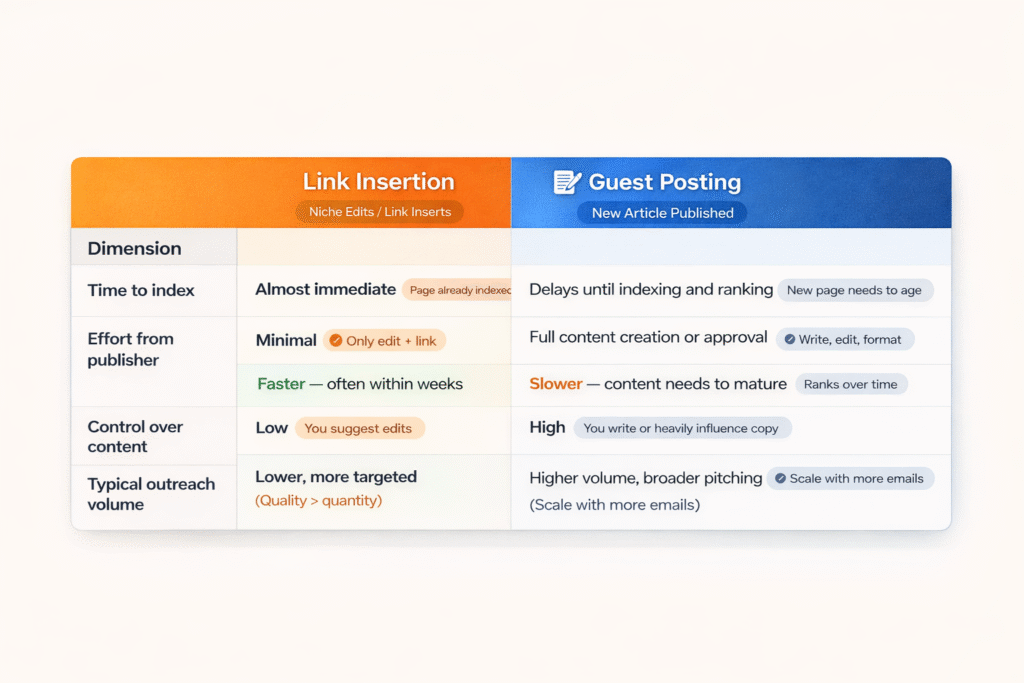
| Dimension | Link insertion | Guest posting |
| Time to index | Almost immediate (page already indexed) | Delays until indexing and ranking |
| Effort from the publisher | Minimal: only edit + link | Full content creation or approval |
| Speed of SEO impact | Faster, often within weeks | Slower; content needs to mature |
| Control over content | Low; you suggest edits | High; you write or heavily influence copy |
| Typical outreach volume | Lower, more targeted | Higher volume, broader pitching |
This suggests that link insertion is ideal when you want faster, leaner, and context‑focused placements, while guest posting is better when brand storytelling and control over the narrative matter more.
What to Avoid vs What to Do in Link Insertion
To keep campaigns clean, compliant, and high‑quality, here’s a quick “do vs avoid” guide:
| What to avoid | What to do instead |
| Placing links in comment sections or footers without editorial context | Place links in natural editorial paragraphs that add value. |
| Mass‑spinning the same template across 500+ emails | Send personalized, short emails tailored to each page and niche. |
| Ignoring relevance and only chasing DR/DA | Prioritize topical relevance and existing traffic signals. |
| Never tracking which targets replied or converted | Log every attempt and use patterns to refine outreach for the next campaign. |
| Using generic anchor text like “click here” or “read more” | Use descriptive, keyword‑rich anchors that feel like natural references. |
As SEO strategist Charles Floate puts it, “Parasite SEO is a result of Google’s link‑based algorithm favoring root domain authority to such a degree that relevancy is chucked out the window.”
This is why, in link insertion, targeting a highly relevant but mid‑authority site is often a smarter long‑term play than blindly chasing big‑domain links that don’t match your niche.
Tips for High‑Quality Link‑Insertion Campaigns
- Prioritize relevance over authority: A low‑DR but highly relevant site in your niche often beats a generic high‑DR blog.
- Avoid “spammy” mentions: Don’t push links into comments, footers, or sitewide widget areas; focus on editorial paragraphs.
- Track every attempt: Use a simple spreadsheet or CRM to log target URL, domain metrics, keyword, outreach date, and result.
Key Takeaways
- Link insertion is a strategic tactic within broader link‑building, not a magic bullet.
- Done well, it helps you leverage existing authority pages and shorten the time to SEO impact.
- Outreach performance is highly dependent on personalization, targeting, and follow‑ups, with most positive responses arriving after the third follow‑up.
Bonus Points
- Reuse existing assets: One strong guide can be pitched as a link insertion in dozens of places across different niches.
- Combine with internal linking: Once a site links to you, strengthen that signal by adding internal links on your own pages pointing back to the same asset.
- Consider outsourcing: For companies that don’t want to manage the minutiae of outreach, a specialized link‑building agency can own the workflow, from content‑audit to reporting, while you focus on core business.
If you’re exploring how to scale link‑insertion‑driven campaigns for your own brand or serving clients, you’re already closer to sustainable SEO growth than chasing cheap directory links or low‑quality guest posts.
2xSaS typically structures such work around these principles by focusing on relevance, fit, and long‑term domain authority. As a result, every link insertion feels like a natural editorial mention rather than a forced backlink.
Want this approach implemented for your brand without the operational overhead? We can run it as a managed service tailored to your niche and goals. Contact us for details.
